startup · full-stack
amc academy
the platform behind a math competition coaching business, from role-based dashboards for students, coaches, and admins to ai-drafted curriculum and automated payment bookkeeping.
- timeline
- aug 2024 — present
- role
- co-founder & cto
- stack
- next.js, postgresql, supabase, nextauth, vercel blob, openai api, python, github actions, docker
$145k
cumulative revenue (cad)
$14k
monthly recurring revenue (cad)
context
amc academy coaches students for math competitions like the amc, aime, and the cemc contests. ethan curtis started it in late 2023 as one person tutoring, and within a few months it had around ten coaches, private students, and weekly group sessions.
a business like that runs on coordination: which coach has which student, what each student is working on, what was covered last week, and who gets paid for what. off-the-shelf tutoring tools weren’t built for competition coaching, and ethan was writing a custom curriculum document for every student by hand. i joined as cto and built the software the business runs on, while ethan focused on marketing and hiring coaches.
the platform
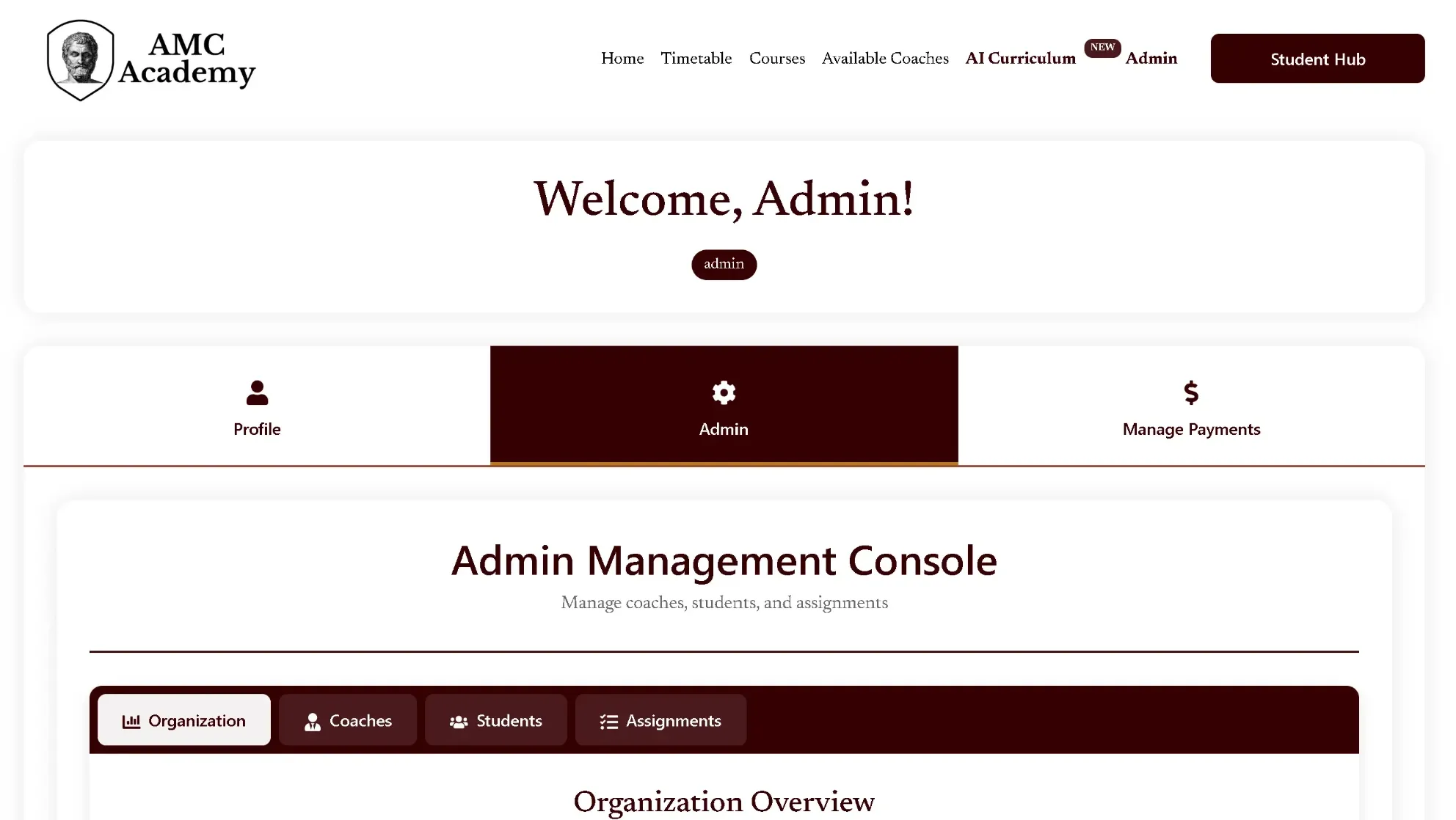
students, coaches, and admins each get their own dashboard. students see assignments, class logs, and resources in the student hub; coaches manage their students and leave feedback; admins get an organization-wide console for coaches, students, assignments, and payments.
how it fits together
it’s one next.js app on vercel, backed by postgresql on supabase. assignment submissions and other files go to vercel blob, curriculum drafts come from openai, and the bookkeeping runs separately on a schedule.
sign-in runs through nextauth. i wanted to own the authentication layer and keep it independent of the database provider. in hindsight that was more than a platform this size needed, but i learned a lot building it.
access is enforced in the database itself with postgres row-level security. a coach’s query only returns their own students and their own pay periods, whichever page or api route asked, so a missed check in application code can’t leak another coach’s data.
building too much
the hardest part was deciding what to build. early on i tried to build everything into the platform: video calls, a calendar, scheduling, all rebuilt from scratch instead of connecting to zoom and google calendar. each piece worked, but none were as good as the tools people already used, and the site was harder to use for it.
the lesson was to build only what’s specific to competition coaching and integrate with everything else. it’s the main thing i’d do differently from day one.
when a class doesn’t happen
pay is where the real-world messiness shows up. a student drops out an hour before class, a coach is sick, a session moves to another day. each of those has to flow through to what the coach is paid and what the family is charged, and the schedule, the class logs, and the payments all have to agree afterwards.
ai-drafted curriculum
coaches used to write every student’s plan from scratch. the curriculum tool takes what we know about a student (their level, target contest, past work, and aime scores) and drafts a syllabus in the same shape as the documents coaches already wrote. the coach edits it and sends it on, so the model does the first draft and the coach keeps the judgement.
it runs on gpt-4o, chosen because it gave good results for students while being cheap enough to meter per use.
bookkeeping on autopilot
payments arrive through both paypal and stripe, and the business’s accounting lives in spreadsheets. python scripts, run on a schedule by github actions, pull transactions from both processors and sync them into the accounting sheets, so nobody copies payments by hand.
results
today the platform serves 25 active students and 9 coaches, and the site gets more than 10,000 visits a month. the business has reached $145k cad in cumulative revenue and $14k cad in monthly recurring revenue, and has been covered by bc business, chek news, and victoria news.
what i’d do differently
scope. i’d start with the smallest set of features only we could provide and plug into zoom, google calendar, and the tools coaches already knew, then earn every custom feature after that. i’d also use supabase’s built-in auth. it would have been enough, and the time would have gone into the parts students actually see.